
Large-scale construction across the Middle East and North Africa rarely happens under one roof. Developers in Dubai, design consultants in Europe, and engineering teams in Cairo routinely collaborate on the same high-rise tower or master-planned community. When these fragmented stakeholders rely on emailing massive local files or uploading static PDFs to disconnected folders, version control breaks down and costly site clashes follow. Adopting cloud-based BIM coordination solves this bottleneck by giving global teams real-time access to live project models directly through a web browser—without requiring every reviewer to install heavy desktop software. Headquartered in Dubai with a regional branch in Cairo, BIM Cloud supports developers, consultants, and contractors across the MENA region with connected digital delivery from LOD 100 through LOD 500.
Company_Profile_BIMCloud.pdf
Why Cloud-Based BIM Coordination Is Replacing Siloed Workflows
For years, multi-disciplinary coordination meant waiting until the end of the week for architectural, structural, and MEP teams to export their native files, upload them to an FTP server, and wait for a coordinator to manually merge them. By the time clash reports were circulated, the underlying designs had already changed. Understanding what is BIM modeling in a modern construction context means recognizing that a 3D model is only as reliable as the Common Data Environment (CDE) hosting it.
Transitioning to cloud-based BIM coordination eliminates these blind spots. Instead of working on isolated local copies, discipline leads author directly inside a shared revit cloud model hosted on platforms such as Autodesk Construction Cloud (ACC). This centralized approach strengthens bim collaboration across every stakeholder: project managers, clients, and site engineers can inspect live 3D geometry, review markups, and approve submittals from any device without needing high-end workstation hardware.
Company_Profile_BIMCloud.pdf
How Real-Time Multi-Disciplinary Coordination Works
Moving models to the cloud does not replace engineering discipline; it amplifies it. Combining cloud collaboration platforms like Autodesk Construction Cloud and Autodesk Forma with authoring and review tools such as Autodesk Revit and Navisworks allows teams to run continuous BIM clash detection throughout design and pre-construction.
Company_Profile_BIMCloud.pdf
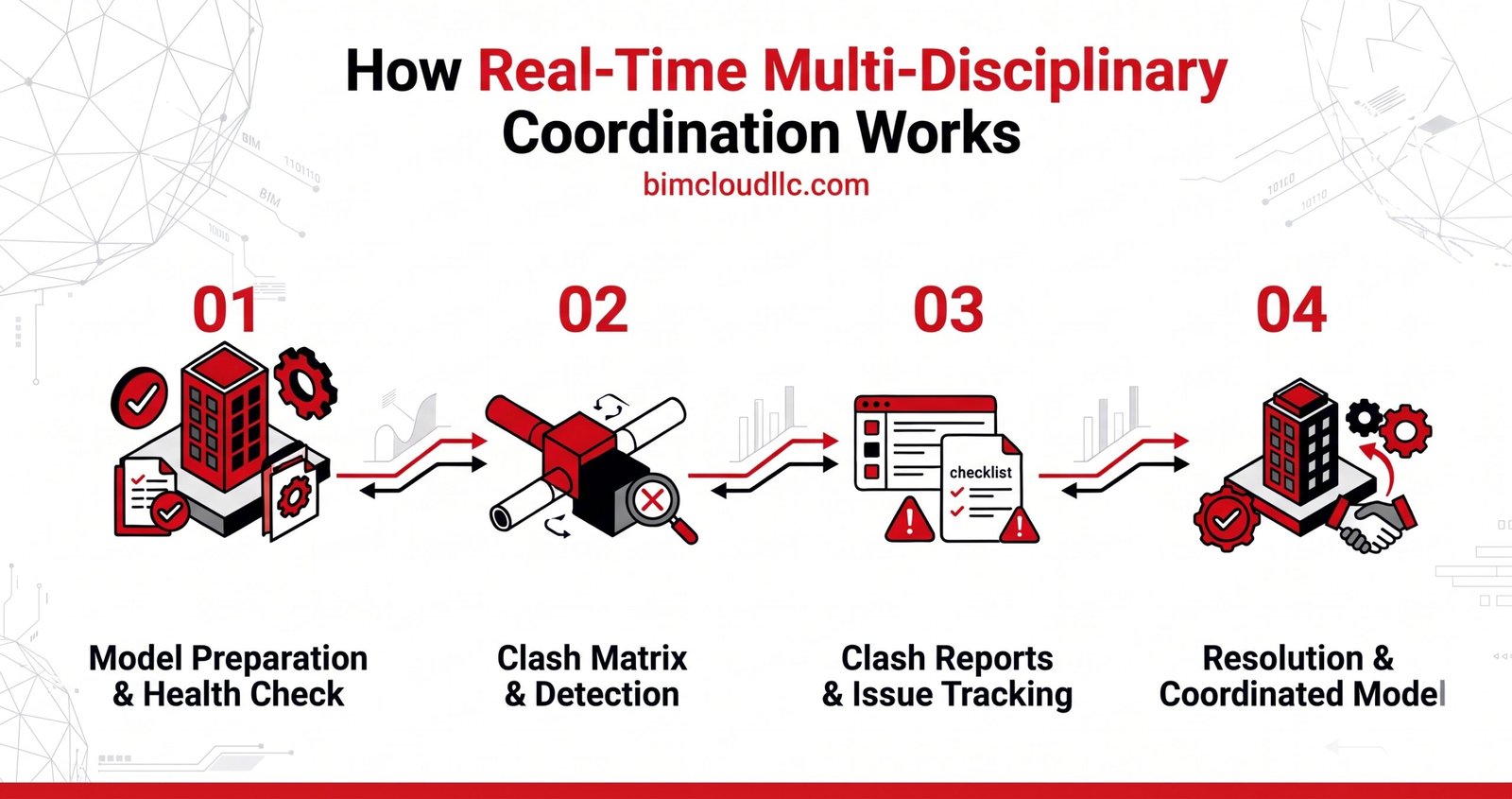
At BIM Cloud, our structured, quality-assured coordination workflow follows four core stages to keep multi-disciplinary models aligned:
- Model Preparation & Health Check: Before any file is federated, discipline models are audited against project standards using formal Model Health Check forms to verify coordinates, naming conventions, and geometry consistency.
- Clash Matrix & Detection: Coordinators configure discipline pairs and spatial tolerance rules to run targeted multi-trade interference checks across architectural, structural, and MEP systems.
- Clash Reports & Issue Tracking: Detected conflicts are logged with status tracking, clear trade ownership, and direct viewpoint links inside live comments trackers so engineers can locate and resolve issues immediately.
- Resolution & Coordinated Model: Discipline leads update native Revit files—verified through ARC, ID, and STR QA/QC checklists—until a clash-free federated Navisworks NWD model is ready for shop drawing extraction.
Company_Profile_BIMCloud.pdf
Scaling Delivery Across Fragmented MENA Teams
Managing a 40-person multi-disciplinary BIM team across multiple time zones requires standardized cloud governance. On complex UAE developments—such as MBR City District One, VELA and ORLA by OMNIYAT, and Ghaf Woods—configuring ACC workflows inside the BIM Execution Plan ensures that every consultant and subcontractor operates from a single source of truth.
Company_Profile_BIMCloud.pdf
For main contractors and design consultancies facing tight tender deadlines, building an internal cloud-enabled BIM department from scratch involves steep licensing and recruitment costs. Partnering with specialized BIM outsourcing companies in Dubai provides immediate access to certified BIM managers, coordinators, and modelers who integrate directly into your existing cloud environment. Through our comprehensive BIM services, teams can leverage cloud-based BIM coordination alongside 4D time scheduling and 5D cost estimation to maintain full visibility over both schedule and budget.
Company_Profile_BIMCloud.pdf
Building a Connected Digital Future
As MENA megaprojects grow in architectural and technical complexity, disconnected desktop workflows can no longer keep pace with site schedules. Investing in cloud-based BIM coordination empowers project teams to catch design conflicts early, reduce on-site rework, and accelerate project delivery from initial concept through facility management handover.
Company_Profile_BIMCloud.pdf
Frequently Asked Questions (FAQs)
What is BIM-based coordination?
BIM-based coordination is the process of combining separate 3D models from architectural, structural, and MEP disciplines into a single federated model to identify and resolve spatial conflicts before construction begins. By resolving physical intersections and clearance issues digitally, project teams prevent costly on-site rework and schedule delays.
What does a BIM coordinator do?
A BIM coordinator manages the technical integration of multi-disciplinary models throughout a project. Their core responsibilities include auditing incoming models for quality and standards compliance, setting up clash detection matrices, running interference tests in tools like Navisworks, chairing coordination meetings, and tracking issue resolution until a clash-free model is approved for construction.
Is BIM collaborate discontinued?
No, Autodesk BIM Collaborate (and BIM Collaborate Pro) is not discontinued. It is Autodesk’s active flagship cloud design collaboration and model coordination solution within the Autodesk Construction Cloud (ACC) platform. Confusion sometimes arises because Autodesk retired older legacy branding—such as BIM 360 Design and BIM 360 Coordinate—as those capabilities were unified and upgraded into BIM Collaborate.