
Why the shop drawing approval process is the Biggest Source of Delay in UAE Projects
In the fast-paced and highly demanding construction landscape of the United Arab Emirates, time is arguably the most valuable commodity. For major fit-out and main building projects across Dubai, shop drawing rejection and resubmission cycles remain one of the absolute largest sources of programme delay. When a project’s timeline starts to slip, it is very often traced back to bottlenecks in the drafting and approval stages. Understanding how to manage these cycles is critical for contractors, consultants, and developers alike.
This comprehensive guide provides a first-hand perspective from a specialized firm that actively manages these intricate workflows on live UAE construction sites. By examining the mechanics of approvals from the ground up, we provide the kind of first-hand authority and insight that no offshore competitor can replicate.
Navigating Consultant Status Codes
When a main contractor or sub-contractor submits technical documents for review, the consultant evaluates them and assigns a specific status code. Knowing these codes inside and out is essential to successfully master the shop drawing approval process. While some minor variations exist depending on the specific contract, the vast majority of Dubai-based projects utilize a standard four-tier coding system:
- Code A (Approved): The ultimate goal. The drawing is approved as submitted, and construction or manufacturing can commence immediately.
- Code B (Approved with Comments): The work may proceed, but it is strictly subject to the contractor incorporating the consultant’s marked-up comments on-site.
- Code C (Revise and Resubmit): The work cannot proceed. The drawing has fundamental errors or omissions and must be corrected and put through another review cycle.
- Code D (Rejected): The submission is entirely unacceptable, often because it completely misses the design intent or violates core local regulations.
Receiving a Code C or Code D means entering yet another review cycle, directly impacting your baseline schedule and exponentially increasing overhead costs.
Understanding Review Cycles for shop drawings and submittals
The journey of shop drawings and submittals from the contractor’s drafting table to the consultant’s desk involves strict scrutiny and contractual timelines. Typically, a standard review cycle in the UAE takes anywhere from 14 to 21 days per submission. If a drawing is slapped with a Code C or D, the clock resets entirely upon the next resubmission.
As a trusted partner for clients across the region, BIMCLOUD serves the AEC sectors with a focus on precision, collaboration, and efficiency. Operating from our Dubai branch office located at Pinnacle Sheikh Zayed Road in Al Barsha First, we provide comprehensive solutions to streamline these grueling cycles. By utilizing advanced BIM modeling technologies, project teams can visualize spatial issues early in the digital environment rather than discovering them on the construction site. We support clients through every phase of the project lifecycle, ensuring smarter construction and sustainable outcomes. Delivering fabrication-ready shop drawings at LOD 400 drastically increases the likelihood of achieving a Code A or B on the very first try.
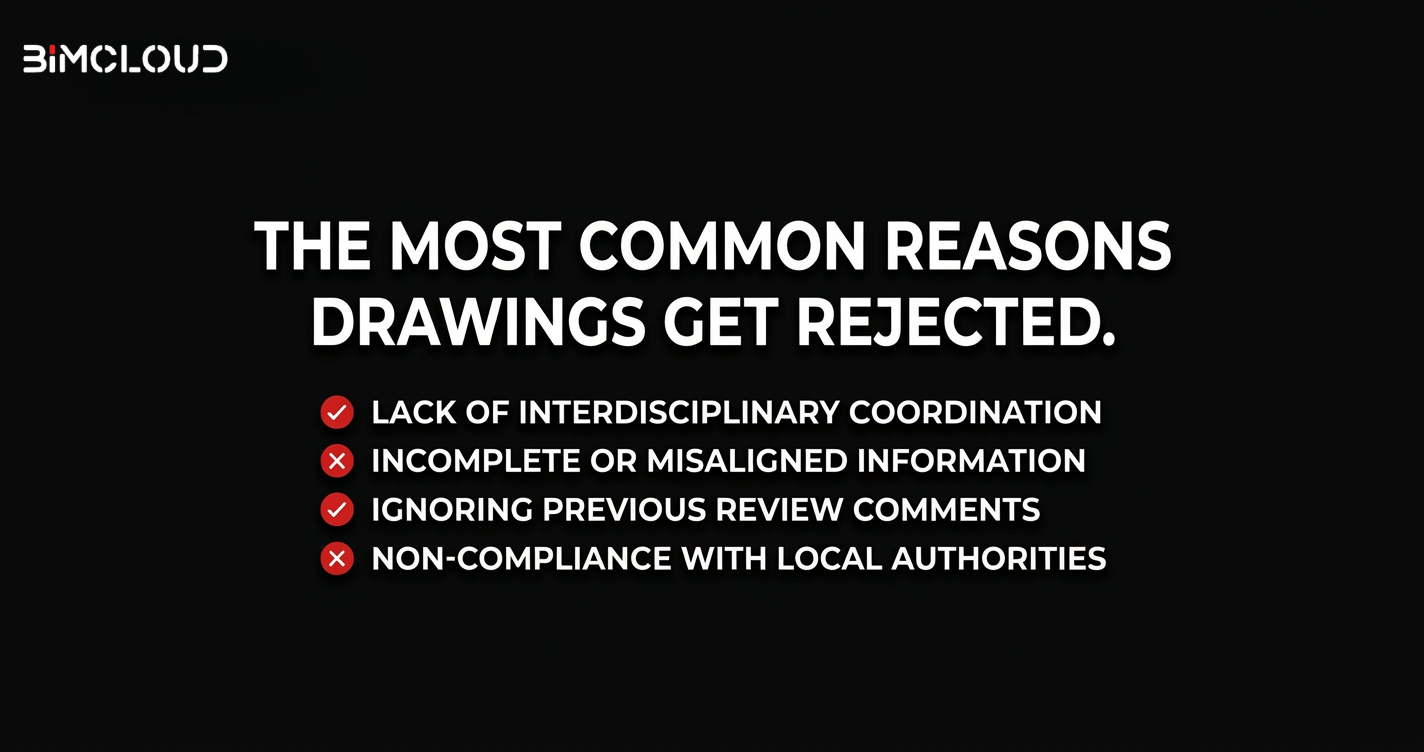
The Most Common Reasons Drawings Get Rejected
Why do so many submittals fail the first round of review? Based on our extensive experience managing a diverse portfolio of live UAE projects, several recurrent issues consistently trigger rejections:
- Lack of Interdisciplinary Coordination: Mechanical, Electrical, and Plumbing (MEP) systems clashing with structural columns or architectural ceilings is a classic failure point. Our coordination services provide a structured approach to identify and resolve clashes before the drawing is ever submitted.
- Incomplete or Misaligned Information: Missing critical dimensions, omitting material specifications, or failing to align the details seamlessly with the primary consultant drawing will practically guarantee a Code C status.
- Ignoring Previous Review Comments: One of the most frustrating things for a consultant is seeing a resubmission that has ignored the specific notes left by the consulting team during the previous round of reviews.
- Non-compliance with Local Authorities: Dubai has stringent regulations governed by Dubai Municipality and Dubai Civil Defence. Failing to reflect these mandatory life and safety systems in the drawings will result in immediate rejection.
How to Optimize Your Submission Strategy
To avoid the dreaded Code C loop, contractors must urgently shift from a reactive mindset to a proactive, quality-driven approach. An optimized shop drawing approval process requires meticulous internal quality assurance before anything is formally submitted to the client.
One of the absolute most effective tools for achieving this is implementing a rigid shop drawing review checklist before any file is uploaded to the project’s Common Data Environment (CDE). This specialized checklist should rigorously verify that all geometry, data consistency, and spatial coordination align perfectly with the mandated project standards.
When executed properly, managing this vital workflow is not just about basic drafting; it is about high-level engineering precision. At BIMCLOUD, we support contractors with highly detailed, fabrication-ready models and shop drawings for all trades to streamline construction and significantly reduce on-site rework. A truly streamlined shop drawing approval process empowers developers, consultants, and sub-contractors to stay on schedule, ultimately driving digital excellence from concept to final digital handover.
Frequently Asked Questions (FAQs)
1. What is the standard turnaround time for reviewing shop drawings in Dubai?
Typically, consultant review cycles take between 14 to 21 days per submission. However, this can vary slightly based on the specific contract terms, the overall size of the project, and the complexity of the specific architectural, structural, or MEP package being reviewed.
2. Can construction begin on-site if a shop drawing receives a Code B?
Yes, in the vast majority of cases, a Code B indicates “Approved with Comments.” You can proceed with manufacturing or on-site execution as long as you strictly and carefully incorporate all of the consultant’s noted corrections into the final built asset.
3. How does Building Information Modeling (BIM) help in reducing shop drawing rejections?
BIM provides a unified platform for teams to work together seamlessly, improving accuracy and reducing design errors. By building a detailed 3D model first, multi-discipline clash analysis can be conducted before producing 2D sheets. This ensures interdisciplinary coordination is achieved digitally, drastically reducing the chances of receiving a Code C or Code D status upon submission.